Wind-Proof Balcony Privacy: What Actually Survives a High-Rise
The ranked list of what actually survives high-rise wind — slatted screens, tied-down mesh, and the ground-floor advice that quietly fails you by the eighth floor.
This post contains affiliate links. As an Amazon Associate we earn from qualifying purchases — at no extra cost to you.
Every balcony privacy list you've saved was written for a patio at ground level, where the worst thing wind does is ruffle a napkin. Move that same setup up eight, twelve, twenty floors, and the curtain that looked so charming in the photo turns into a wind sock by the first real gust — pulling at its rod, snapping a zip tie, occasionally taking a lightweight planter with it.
This is that list, rewritten for up here. Nothing below made the cut because it looked good in a mockup — it made the cut because it holds once the wind is actually working against it, which is a very different test. If you're on a lower floor with a building or two breaking the worst of it, our full no-drill balcony privacy toolkit covers the complete method list, since a couple of ideas that don't belong on this page work perfectly well down there. Up here, the ranking changes.
1. Slatted Bamboo or Reed Roll Screens — Let the Wind Move Through
A solid surface and a woven one meet wind completely differently, and that difference is the whole game at height. A flat panel has to absorb a gust in one place, all at once. A slatted bamboo or reed roll is full of small gaps instead, so the wind passes through dozens of tiny openings rather than slamming into one continuous wall — less force ever reaches the ties holding it up, because less force ever gets stopped.
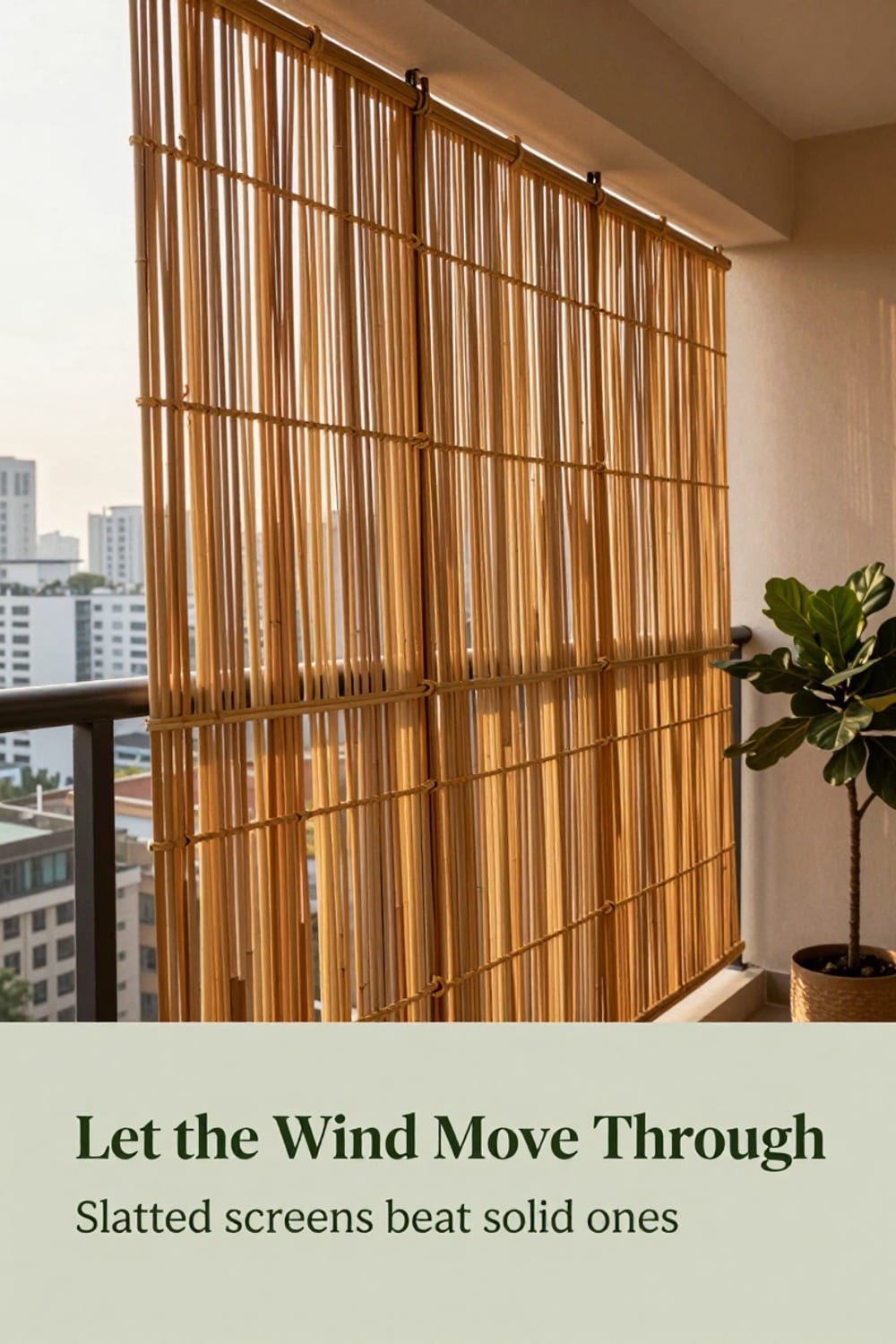
A reed screen that looks almost see-through when you hold it up to a window is usually the better high-rise choice over a denser weave that feels more private in the store — you're trading a little coverage for a screen still standing by the end of the season. Our full breakdown of weave density, roll length, and how tight you can go before a weave starts acting like a solid panel again lives in our bamboo balcony privacy screen guide.
2. HDPE Mesh Screens With Grommets — Tie Every Single One
Knitted HDPE mesh — the same material behind shade sails and wind-rated patio screens — works on that same let-the-air-through principle, just engineered specifically for exposure. Look for one described as wind-rated or shade-rated rather than a decorative lattice print, edged in reinforced grommets every twelve to eighteen inches around the entire perimeter, not only at the corners.
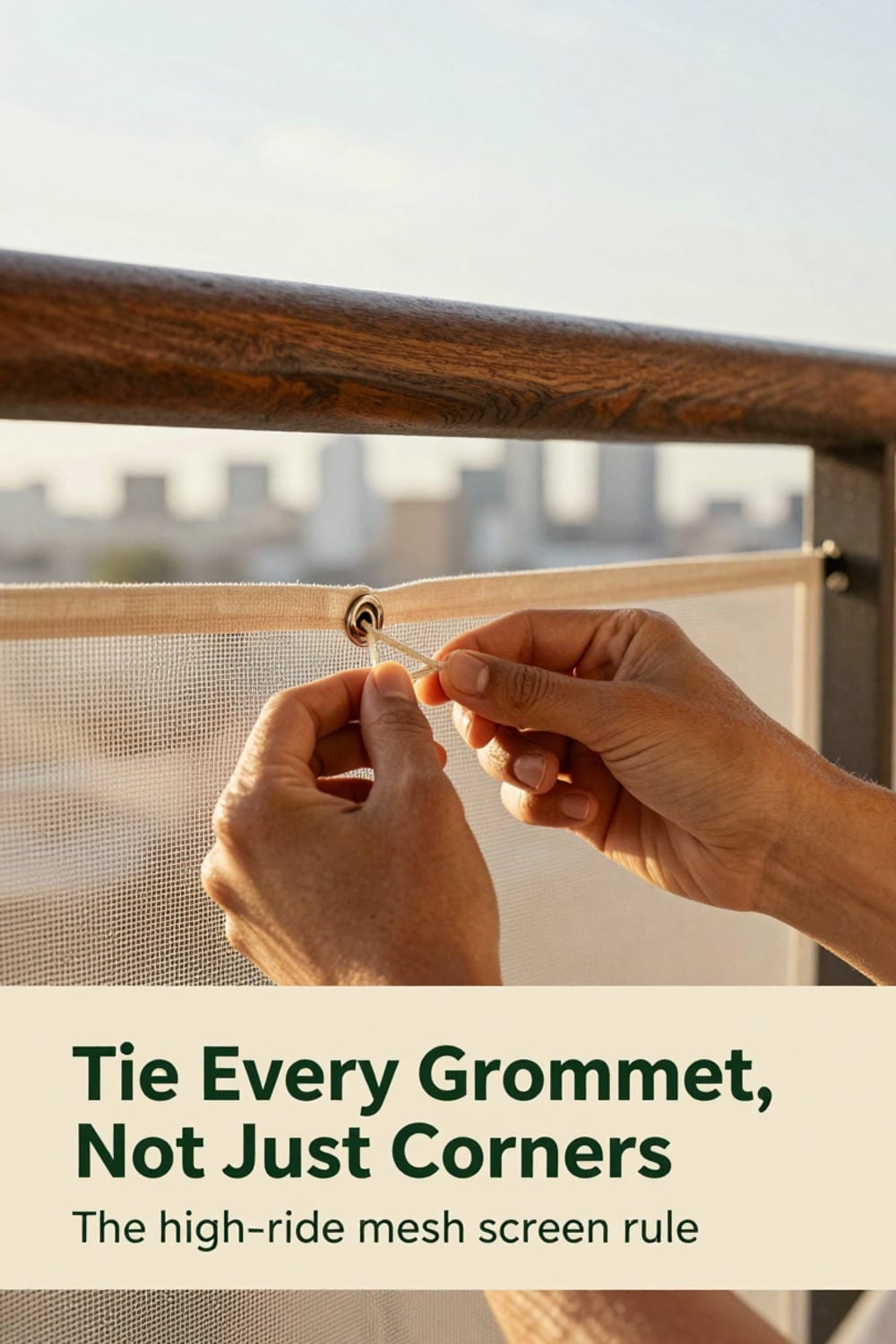
That last detail matters more than the screen itself. Tying only the four corners is the ground-floor way to hang one, and it works fine down there because there's rarely enough wind to test the fabric in between. Up here, every ungrommeted stretch is free to billow, and repeated billowing is exactly what tears a grommet loose — usually the one holding the loosest section, not the weakest one. Tie every grommet the screen came with.
3. The Double-Row Zip-Tie Pattern
Whatever screen you land on, the tie pattern is doing more of the real work than people give it credit for at height. A single row along the top rail is standard on a ground-floor patio, and it's usually enough down there. Up here, run a second row along the bottom rail too, with ties spaced roughly a foot apart on both rows instead of every few feet.
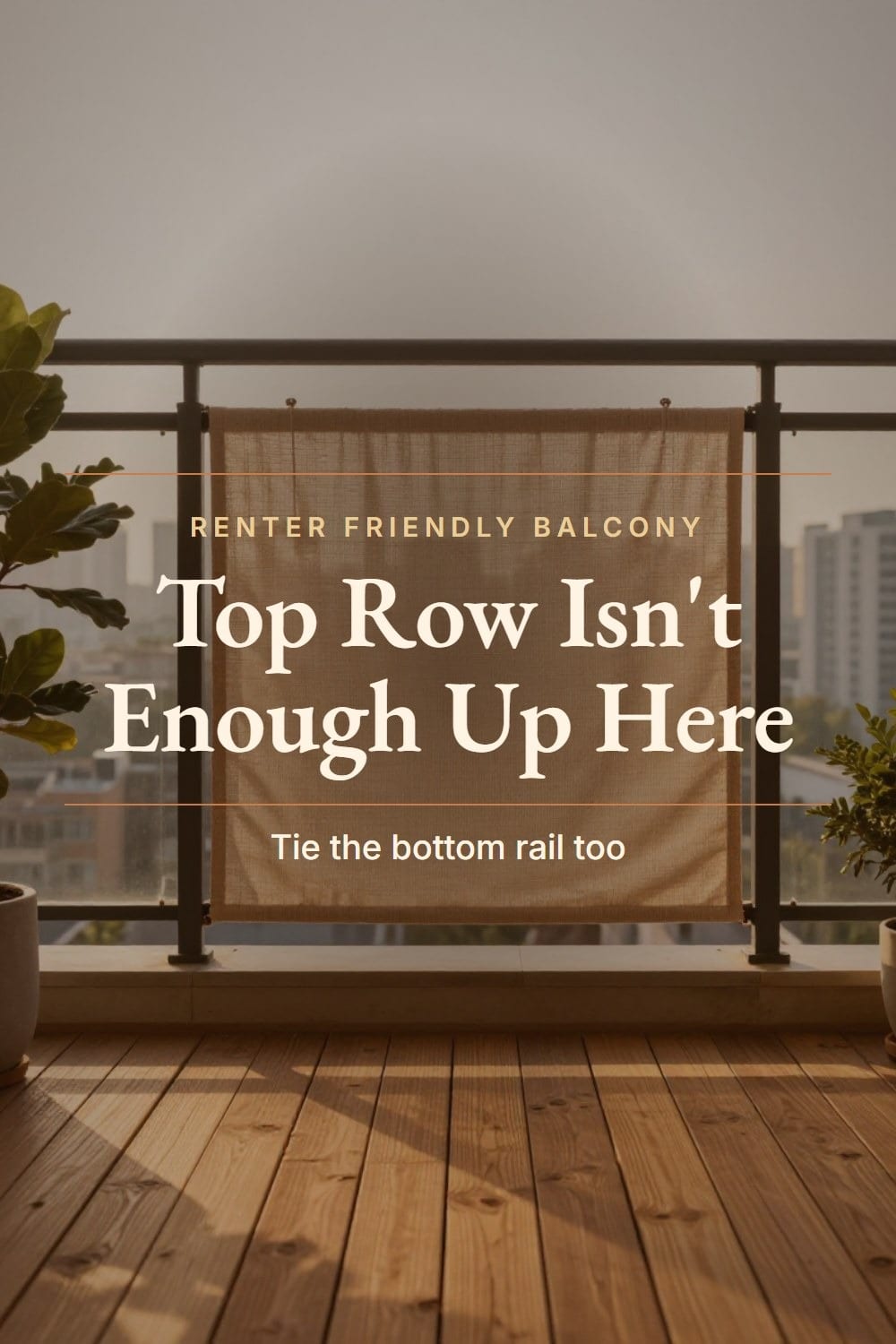
The second row keeps the bottom edge from becoming its own sail that flaps independently of the top — exactly what a loose bottom edge will do the first time real wind comes through. Use UV-resistant ties rather than whatever came in a general hardware multi-pack; a season of direct sun makes an ordinary tie brittle enough to snap under load instead of just holding.
4. Ball Bungees as Shock Absorbers
A rigid zip tie has zero give — it holds completely or snaps completely, with no in-between once a hard gust loads the fabric against it. Swap at least your top row for ball bungee cords, the small elastic cords with a ball on each end sized for exactly this kind of attachment, and you've added the one thing a rigid tie can't offer: stretch.
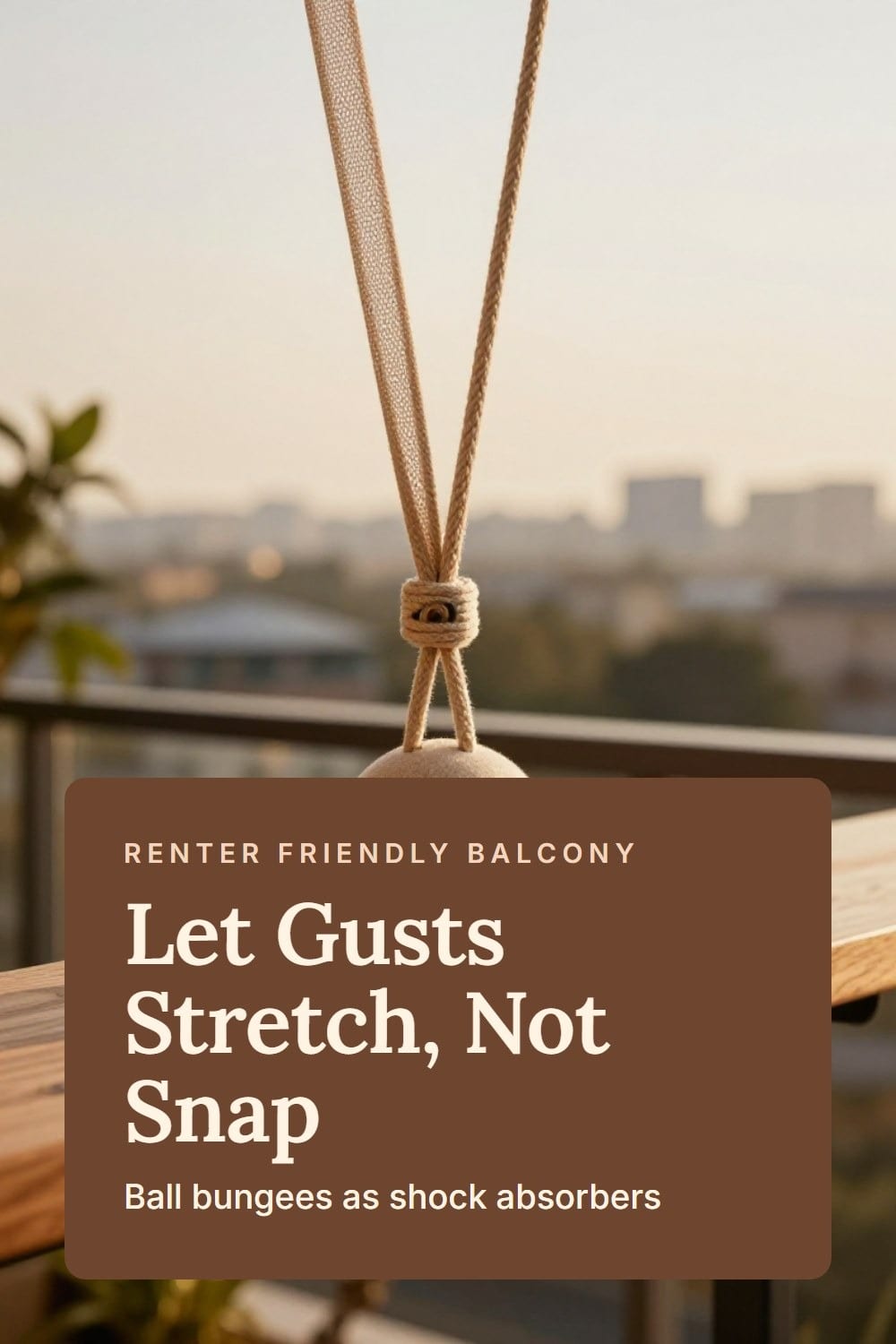
It's the same logic as a bungee on a roof rack. A hard gust pulls the cord taut, the stretch absorbs the force, and it releases back to resting length once the gust passes — instead of sending the full hit straight into a strained tie or grommet. A screen rigged with a mix of bungees and ties tends to sound different in real wind, too: a soft give instead of a taut hum right before something lets go.
5. Low, Wide, Weighted Planters
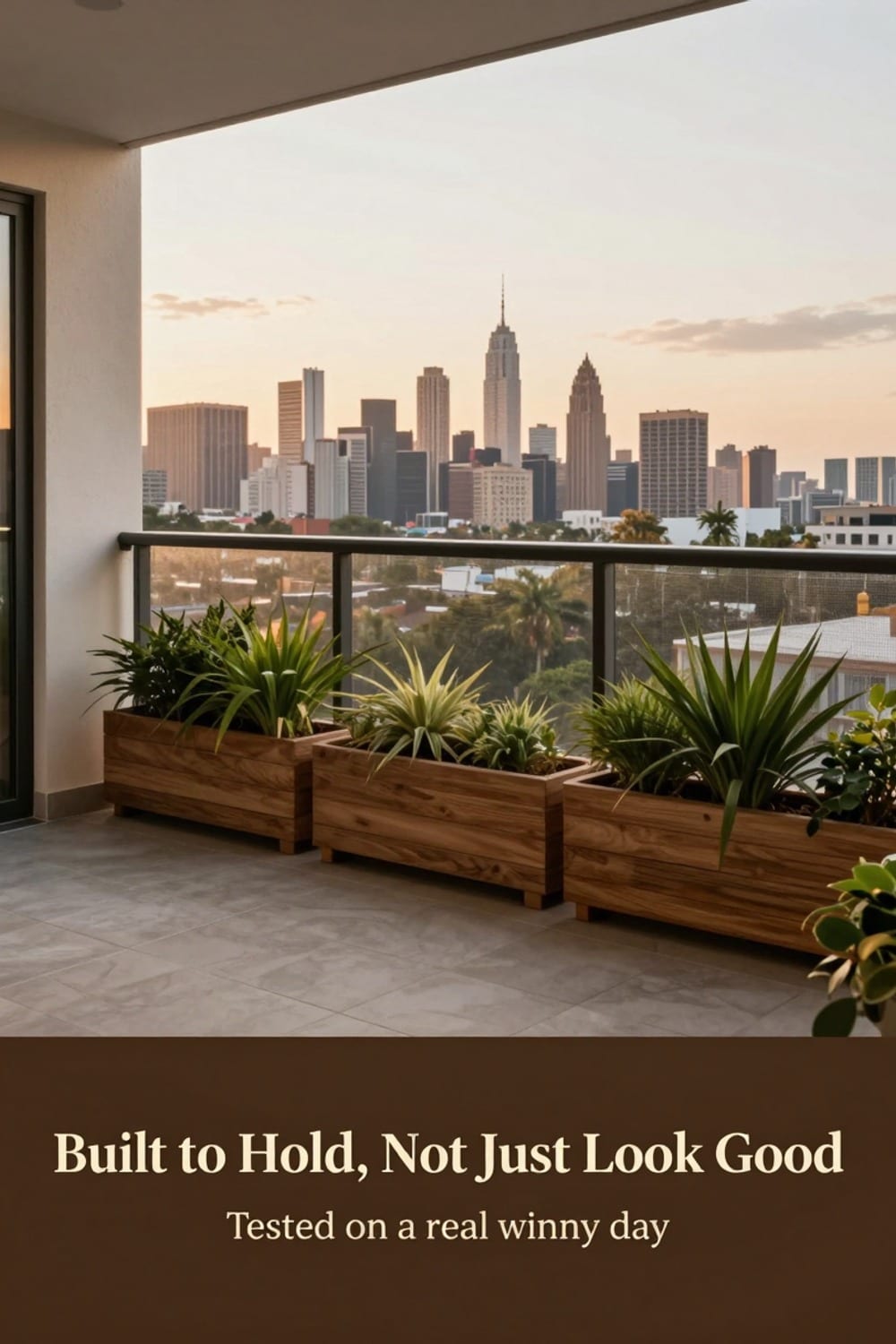
Tall and narrow versus low and wide isn't just a style choice at height — it's the difference between a planter that holds its ground and one that goes over the railing. Wind grabs the foliage above the rim and uses the pot's base as a pivot point, the same way a lever works. A tall, narrow pot carries most of its weight high up and far from that pivot, so it takes very little force to tip. A low, wide pot holds the same soil close to the ground, near the pivot, and needs far more force to move at all.
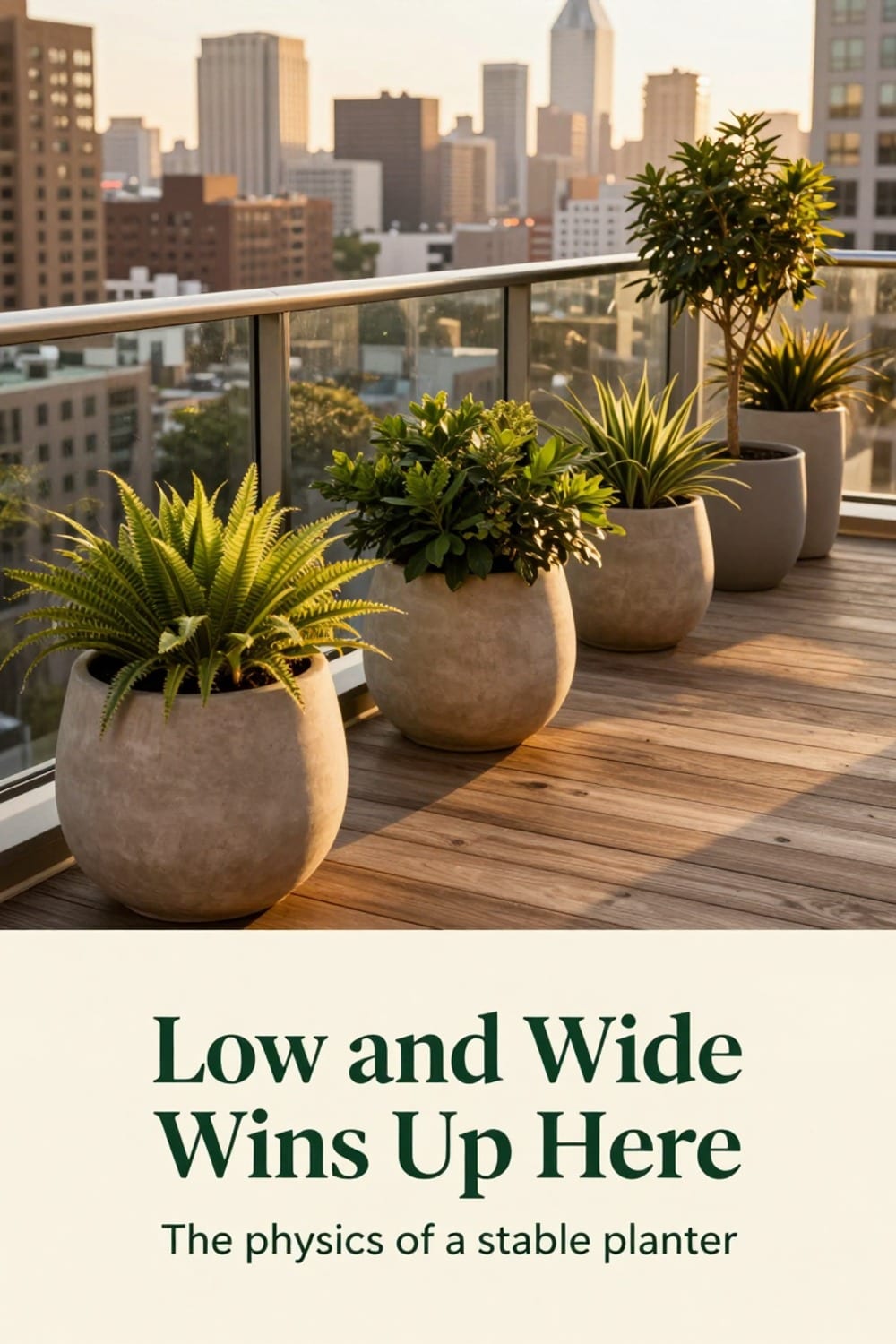
If your privacy plan genuinely needs height, cluster a few shorter, wide planters instead of relying on one tall one, and give the wide, weighted planters the windward corner — the spot that catches the wind first. A sandbag-style weight tucked at the base of any planter adds stability without changing how it looks from where you sit.
6. A Pressure-Fit Screen for the One Direct Sightline
For a single, specific problem — usually a shared wall with the balcony next door — a pressure-fit or spring-loaded screen wedges floor-to-ceiling on tension alone, the same way a tension rod holds itself in a doorway, just scaled up. A fabric or slatted panel attaches to the pole once it's wedged in place.
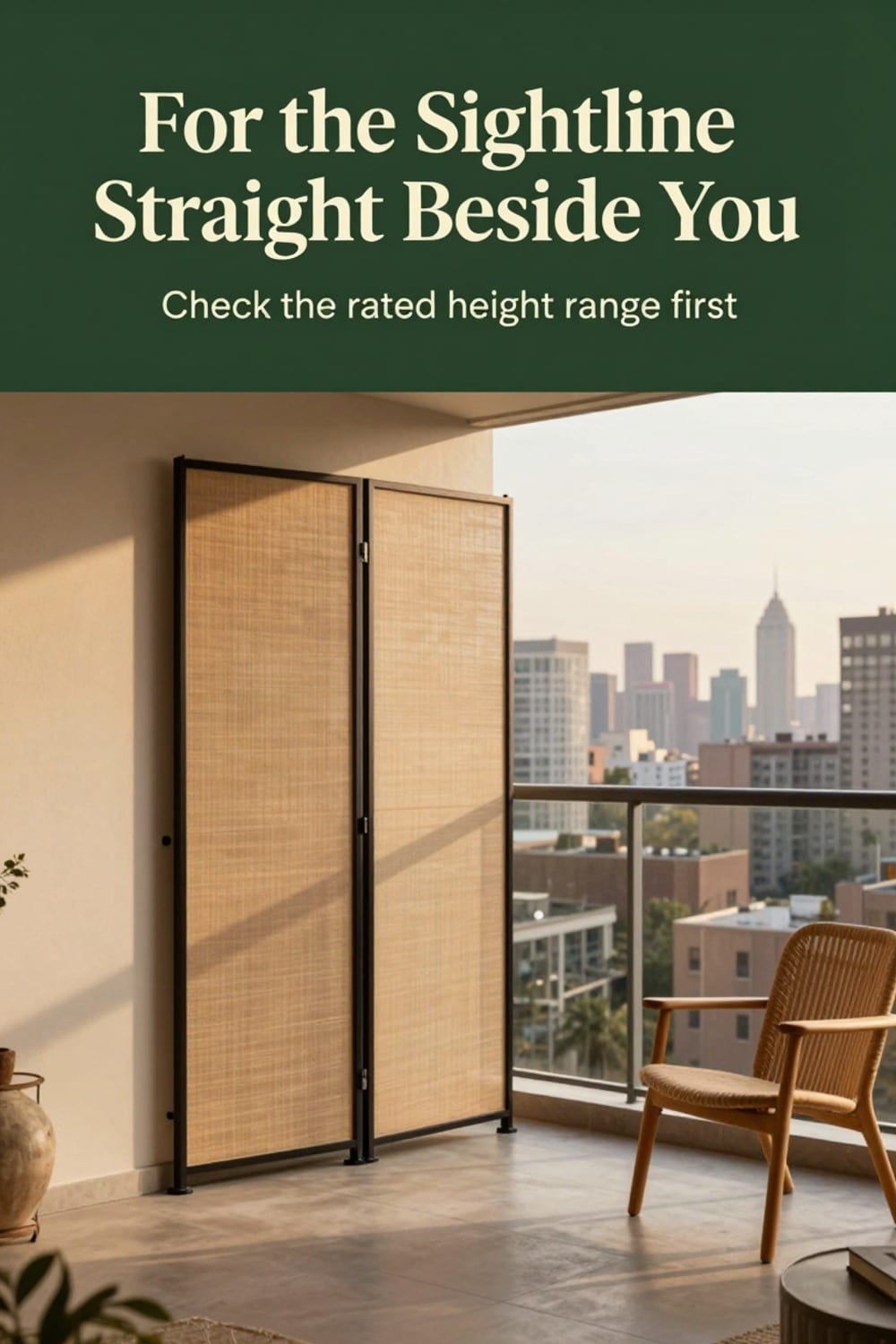
Measure your actual ceiling height against the kit's rated adjustment range before you buy, not just its longest possible extension. A pole wedged in near the very top of its range has noticeably less spring tension holding it than one sitting in the middle of that range, and that gap matters more at height than on a sheltered patio. When in doubt, size down to a kit where your ceiling falls closer to the middle of its range.
What Actually Fails Up Here (Even Though It's Fine on the Ground Floor)
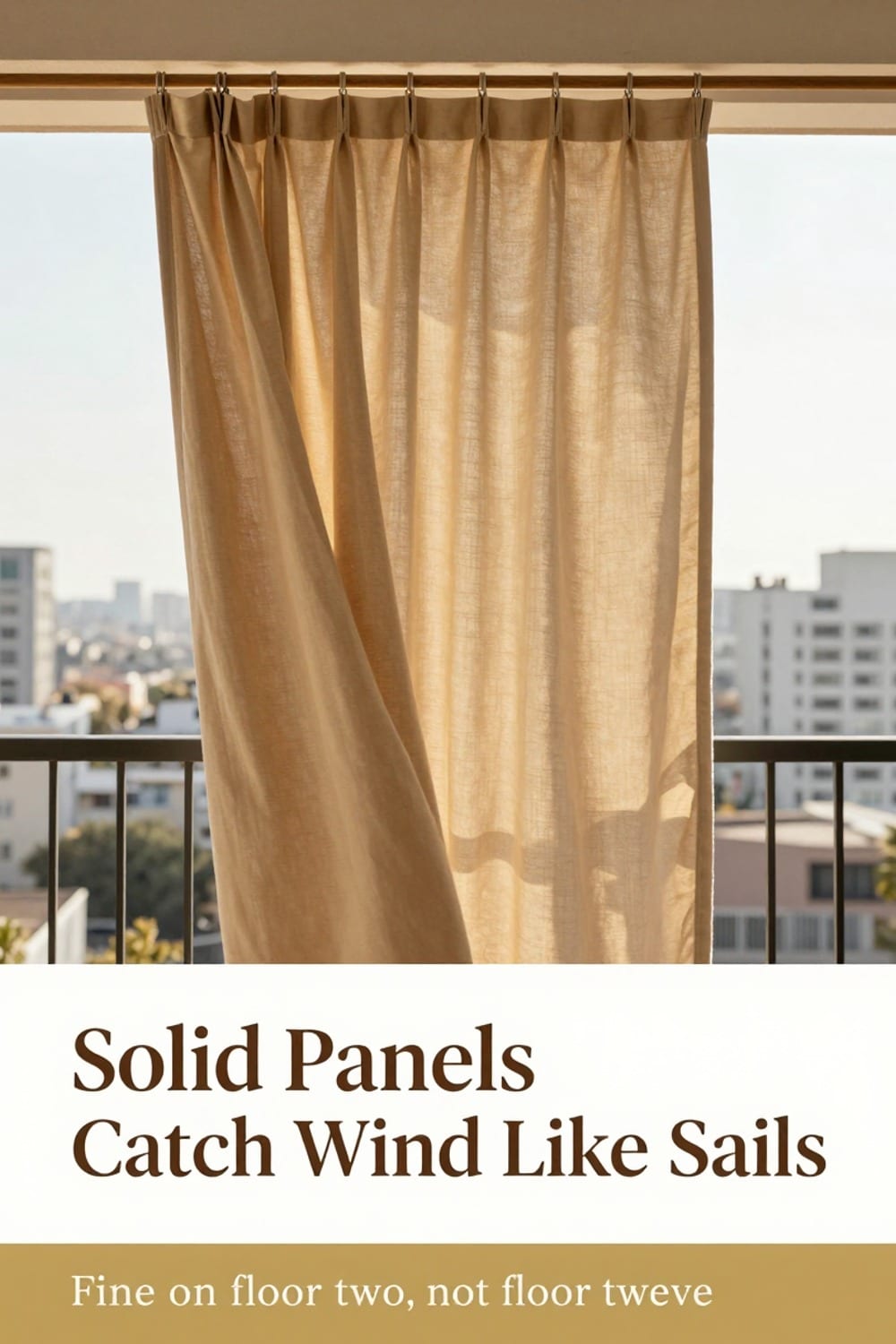
A fully solid outdoor curtain is the biggest offender, mostly because it's also the most tempting option in every product photo. Wall-to-wall solid fabric is the largest continuous sail you can build on a balcony, and the taller the drop, the more square footage that gust has to push against. Love a solid curtain on floor two. Reconsider it on floor twelve, unless it can hang across a recessed section with a building wall already breaking the direct wind — the fully open railing side is the wrong spot for it up here. The same logic covers a fully solid faux hedge panel, which is still a solid surface even though it reads as greenery; our faux hedge balcony screen guide covers which panel styles actually have airflow built into the weave versus which are fully solid, and where each one belongs.
Lightweight freestanding metal or wicker screens are the second common failure. They tuck behind a railing and rely entirely on their own weight to stay put on a flat floor, which is fine at ground level where wind rarely tests it. Up here, the same gust a tied-down mesh screen shrugs off just tips a freestanding one straight over, because nothing is actually anchoring it to anything.
Adhesive-mount hooks and strips are the quiet third failure. They hold through surface tension and glue, both of which soften in direct sun over a hot afternoon — and the same heat-softened adhesive that's barely holding by evening is the one letting go the exact moment a gust loads whatever it's holding. Save adhesive mounts for anything indoors or fully shaded, and use a rated clip or tie for anything that has to survive real wind.
The Physics, in Plain Terms
None of this is about your building being unusually harsh — it's just what height does everywhere. At ground level, wind gets broken up by trees, parked cars, fences, and the buildings around you before it ever reaches your patio. Climb high enough and you're above most of that interference, so the wind reaching your railing is steadier and less interrupted than anything a ground-floor patio ever deals with.
Corner units and unusually exposed faces make this more pronounced, since they catch wind from more directions instead of sharing the load with neighboring balconies. None of that makes privacy impossible at height — it just means the same screen that holds for years on a sheltered first-floor patio is doing a genuinely harder job up here, and it's worth rigging it like the job is harder, not identical.
The Windy-Day Test Before You Trust Any of It
Don't trust any setup based on the calm afternoon you installed it. Wait for a normal windy day — not a storm, just ordinary blustery weather — and stand out there for ten minutes watching every tie point and panel edge. Look for a grommet stretching further than the ones around it, a tie creaking taut instead of holding quietly, or a planter rocking rather than swaying with the gusts.
Fix or reinforce anything that moves more than the rest of the setup before you call it finished, not after it's already let go once. A tie that snaps or a planter that tips is more than an inconvenience at this height — it's a real object with somewhere real to land. For exactly what that kind of mistake costs at move-out, see our balcony privacy deposit mistakes guide.
What Your Lease (or HOA) Actually Allows
"No drilling" is rarely the only balcony rule in a high-rise lease. Buildings with shared exteriors often add restrictions a ground-floor rental never mentions — what's visible from the street or other units, whether anything can hang past the railing line, and sometimes a specific note about attachments above a certain floor, because of the drop involved if something comes loose. Read your balcony clause in full, not just the paragraph about holes, and if it's genuinely silent on privacy screens, a quick message to your building manager asking specifically about a tied, tool-free screen is worth sending before you buy anything.
When an Actual Storm Warning Hits, Bring It In
Everything above should survive an ordinary windy day — that's the whole point of building it this way. An actual storm warning is a different situation and deserves a different response. Bring in anything that could become a projectile: loose cushions, smaller planters, anything not firmly tied down, and any panel light enough to lift off its own rail in genuinely severe gusts.
This isn't a failure of the setup — it's just the high-rise version of bringing patio cushions in before a storm at ground level, with higher stakes given how far anything that comes loose has to fall. If your balcony also deals with real cold and wind through the fall and winter months, our cold-climate fall balcony guide covers the seasonal side of the same exposure problem.
A handful of specific products cover every method on this list, and the difference between the ones that hold and the ones that don't usually comes down to the exact product, not just the general idea.
The wind-specific upgrades behind every method on this list — the difference between "this should work" and "this actually held through the season."
| Product | Best for | Why we like it |
|---|---|---|
| Balcony Privacy Mesh Screen with Grommets every grommet gets its own tie, so wind passes through the weave instead of loading one continuous surface. | a wind-rated screen with reinforced grommets around the entire perimeter | every grommet gets its own tie, so wind passes through the weave instead of loading one continuous surface. |
| Slatted Bamboo Reed Roll Screen the open weave lets wind move through instead of catching it like a solid panel. | a natural-textured screen along a full railing run | the open weave lets wind move through instead of catching it like a solid panel. |
| Heavy-Duty UV-Resistant Zip Ties UV-rated ties stay flexible through a season of direct sun instead of going brittle and snapping. | the double-row tie pattern on any mesh or reed screen | UV-rated ties stay flexible through a season of direct sun instead of going brittle and snapping. |
| Ball Bungee Cords a bungee stretches under a hard gust and releases, instead of transferring the full force into a rigid tie. | adding stretch to the top row of any screen attachment | a bungee stretches under a hard gust and releases, instead of transferring the full force into a rigid tie. |
| Canopy Sandbag Weights extra weight low at the base lowers the center of gravity without changing how the planter looks. | anchoring the base of a tall or freestanding planter | extra weight low at the base lowers the center of gravity without changing how the planter looks. |
| Low Wide Outdoor Planter a low, wide base holds the same soil weight far closer to the ground, which resists tipping better than a tall pot. | a wind-stable planter for the exposed or windward corner | a low, wide base holds the same soil weight far closer to the ground, which resists tipping better than a tall pot. |
Frequently asked questions
Will a mesh or bamboo screen really hold up better than a solid curtain at this height?
How do I know if my balcony counts as genuinely exposed?
Do I need to reinforce every method, or just the solid ones?
What's the single easiest upgrade if I already have a screen installed?
Is a low, wide planter really safer than a tall one holding the same weight?
Should I bring my whole setup down before every windy day?
Maeve Sinclair
Founder & Editor
Maeve is a renter-turned-balcony-obsessive in Asheville who spent years making tiny outdoor spaces feel like boutique escapes — no drilling, no big budget. She started Amber Nook to share the exact, doable formulas.
Amber Nook is a participant in the Amazon Services LLC Associates Program, an affiliate advertising program designed to provide a means for sites to earn advertising fees by advertising and linking to Amazon.com. As an Amazon Associate we earn from qualifying purchases. This means if you click a link and buy something, we may receive a small commission at no additional cost to you. We only recommend products we genuinely believe are useful.
keep reading
You might also love
Interlocking faux boxwood panels give a rented balcony year-round privacy with zero watering and zero drilling — if you attach them so wind can't take them out. Here's how to hang it, wind-proof it, and keep it from looking like the cheap version.
Cozy Fall Balcony Ideas for Apartments: 15 Ways to Warm Up a Small Space15 renter-safe ways to turn a small apartment balcony into a warm, blanket-weather retreat this fall — no drilling, no deposit risk.
Renter-Friendly Fall Balcony Makeover: A Real Before & AfterA bare concrete rental balcony becomes a cozy fall corner in one weekend — no drilling, deposit safe, under $180.